

Chikungunya has been circulating in Mauritius through 2026, and the questions that reach us at night are nearly always the same three: is this chikungunya or dengue, what can be taken safely for the pain, and how do you know when it has stopped being something to manage at home.
Most people who catch it recover at home without ever needing a hospital. Two parts of it are worth getting right, though, because that is where the avoidable harm happens: the painkiller reached for in the first few days, and the point at which you stop waiting and call.
What chikungunya actually is
It is a virus carried by mosquitoes. In Mauritius the one that matters is Aedes albopictus, the striped mosquito that bites in daylight rather than at night, most often in the early morning and the late afternoon. It breeds in very small amounts of clean, still water: the saucer under a plant pot, a blocked gutter, a bucket left in the yard, the rim of an old tyre.
It does not pass from person to person. A household tends to fall ill together because the same mosquitoes are biting the same people, not because they are giving it to one another. Symptoms usually appear between three and seven days after the bite.
What it feels like
Chikungunya announces itself. Most people can name the hour it started.
- A fever that comes on abruptly, often with a headache
- Joint pain that is symmetrical: both wrists, both hands, both ankles, both feet
- Stiffness at its worst in the morning, easing a little with movement
- A rash on the trunk and limbs, usually appearing a few days in
- Fatigue out of all proportion to the rest of it
The fever generally settles within about a week. The joint pain does not always leave with it. In a proportion of people it lingers for weeks, and in some for months. That is a recognised feature of the illness rather than a sign that something has been missed, but if it is not improving, it should be reviewed rather than endured.
Chikungunya or dengue? Why the first few days matter
Early on the two look alike: abrupt fever, headache, aching, rash. They are carried by the same family of mosquitoes and circulate in the same season. Chikungunya tends to hurt most in the joints and dengue behind the eyes and in the muscles, but neither pattern is reliable enough to bet a treatment on.
Until a doctor has ruled dengue out, avoid aspirin, ibuprofen and diclofenac. The anti-inflammatories many households keep for joint pain are precisely the wrong ones here: dengue lowers the platelet count, and these medicines add to the risk of bleeding on top of it. Paracetamol is the one to use while the diagnosis is still open. If someone has already taken an anti-inflammatory, say so when you call. It is useful information, not a confession.
What to do at home in the first few days
1. Rest, and expect to need more of it than you think
This is not an illness to work through. The fatigue is part of it, and people who push against it in the first week tend to have a longer second week.
2. Drink more than you feel like drinking
Fever, sweating and a poor appetite dehydrate people quickly, and dehydration makes every other symptom worse. Water, oral rehydration salts, soup, coconut water: the form matters far less than the volume.
3. Paracetamol for the fever and the pain
At the dose printed on the packet, and no more. If it is not touching the pain, that is a reason to telephone rather than a reason to add something stronger from the cupboard.
4. Keep the patient away from mosquitoes for the first week
This is the step most households skip. In the early days of the illness there is enough virus in the blood for a mosquito to pick it up and carry it to the next person. A net over the bed, repellent and screens on the windows protect everyone else in the house, not the patient.
When to call a doctor
For most people the honest answer is: whenever you would rather have it looked at than guessed at. Specifically, call if:
- The fever is still there after about five days, or it settled and has come back
- The pain is not answering paracetamol
- There is repeated vomiting, or fluids are not staying down
- Urine has become dark, or there has been very little of it
- The patient is over 65, pregnant, a newborn, or lives with diabetes, heart disease, high blood pressure or kidney disease
That last group is not a warning that something will go wrong. It is simply the group in whom dehydration and the strain of a fever are least well tolerated, and in whom a doctor would far rather see the patient early than late.
Do not wait for a home visit. Go to the nearest hospital emergency department or call SAMU on 114 if there is bleeding from the gums or nose, blood in vomit or stool, severe abdominal pain, breathlessness, confusion or unusual drowsiness, a fit, or a fever in a baby under three months.
What a doctor does at the house
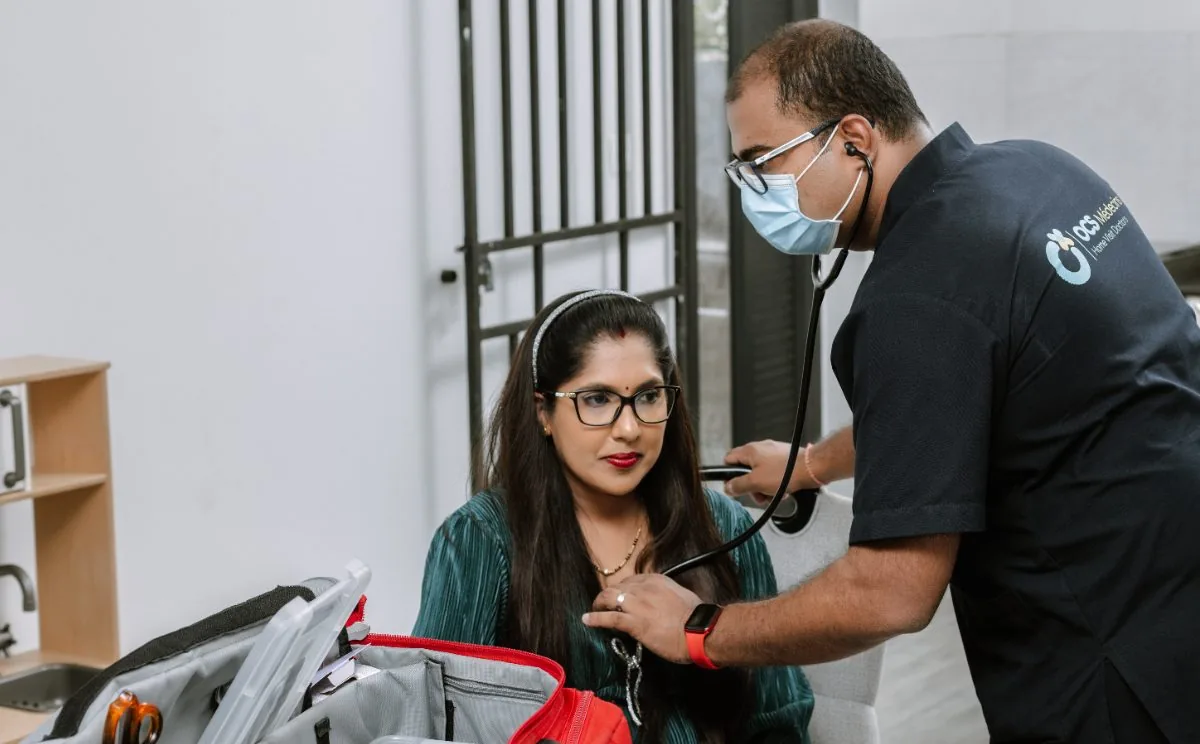
A home consultation for a suspected mosquito-borne fever is a full examination (temperature, pulse, blood pressure, hydration, the joints, the rash, the abdomen) followed by a decision about testing. Blood can be taken at the address, including a full blood count and platelets, which is the test that separates a straightforward viral illness from one that needs watching.
The other thing worth doing during the visit is a look through the regular medicines. Several common prescriptions (blood pressure tablets, diuretics, diabetes medicines, blood thinners) behave differently in someone who is febrile and not drinking. That review is often the most useful five minutes of the consultation, and it is close to impossible to do properly over the telephone.
Stopping it at your own gate
Aedes albopictus does not travel far. The mosquito biting you was very probably born within a hundred metres of where you are sitting, which means the yard is where this is won or lost. Once a week is enough:
- Empty and scrub the saucers under plant pots
- Turn over buckets, watering cans, wheelbarrows and old tyres
- Clear the gutters, and check that they still drain
- Cover water drums and tanks
- Change the water in animal bowls and cut-flower vases
Scrubbing matters as much as emptying: the eggs stick to the sides of a container and survive a dry spell perfectly well.
How widespread it is
More than 2,800 locally acquired cases were confirmed between January and mid-May 2026, concentrated in lower and middle Plaines Wilhems (Beau Bassin, Rose Hill, Quatre Bornes, Vacoas, Phoenix and Curepipe) with cases reported elsewhere on the island as well.
Those numbers move week by week. For the current position, and for any public health guidance in force, the Ministry of Health and Wellness is the source to check rather than this page.
Frequently asked questions
Is there a treatment for chikungunya?
There is no antiviral that cures it. Treatment is aimed at the fever, the pain and the dehydration, which for most people is enough. What a doctor adds is certainty about the diagnosis, pain relief that is safe to take, and someone watching for the small number of cases that do not follow the usual course.
Is there a chikungunya vaccine available in Mauritius?
Chikungunya vaccines exist internationally. Whether one is available or recommended here, and for whom, is a question for the Ministry of Health and Wellness or your own doctor rather than something to settle from a web page.
Can chikungunya spread from person to person?
No. It is carried by mosquitoes, not by contact. Households fall ill together because they share the same mosquitoes, which is why protecting the patient from bites during the first week is what stops it going round the family.
How long does chikungunya joint pain last?
The fever usually clears within about a week. Joint pain often outlasts it by several weeks, and sometimes by months. If it is not improving it should be reviewed rather than endured.
Can a doctor treat chikungunya at home in Mauritius?
Yes. A day consultation between 7am and 7pm is Rs 2,000 and a night consultation between 7pm and 7am is Rs 3,000, at the same rate anywhere on the island. Blood can be taken at the address.
Need a doctor at the house?
One number, any hour, anywhere in Mauritius.